


Corporate governance
- HOME
- Corporate Information
- Corporate governance
Corporate governance
1.Basic View
Corporate governance in the Company is based on our Values. To build good relationships with stakeholders with whom we have various interests and become a company that continues to be trusted, we believe it is essential to build a system that functions to enhance management transparency and fairness to enable prompt decision making that leads to sustainable growth and increased corporate value.
2.Values
There are five "CKD Values" that each and every CKD Group employee share and value for realizing the Purpose.
C-SHIP, which stands for Customer, Sustainability, Human, Innovation, and Professionalism, is an abbreviation of CKD-SHIP and indicates the "character of CKD" or "CKD-ness".
Customer “Customer first”
We will grasp our customers' true concerns and deliver excitement through solutions that create new value.
Sustainability
Together with our stakeholders, we aim to realize a sustainable global environment and society
Human “Human resource”
We will build a happy future by cultivating ourselves and joining forces with our diverse colleagues.
Innovation
We will break out of the shell of common sense and constantly evolve through challenge and co-creation.
Professionalism
We will continue to be an irreplaceable presence by enhancing our professional capabilities and producing results that exceed expectations.
3.Basic Policy on Corporate Governance
 (379KB)
4.Corporate governance organization
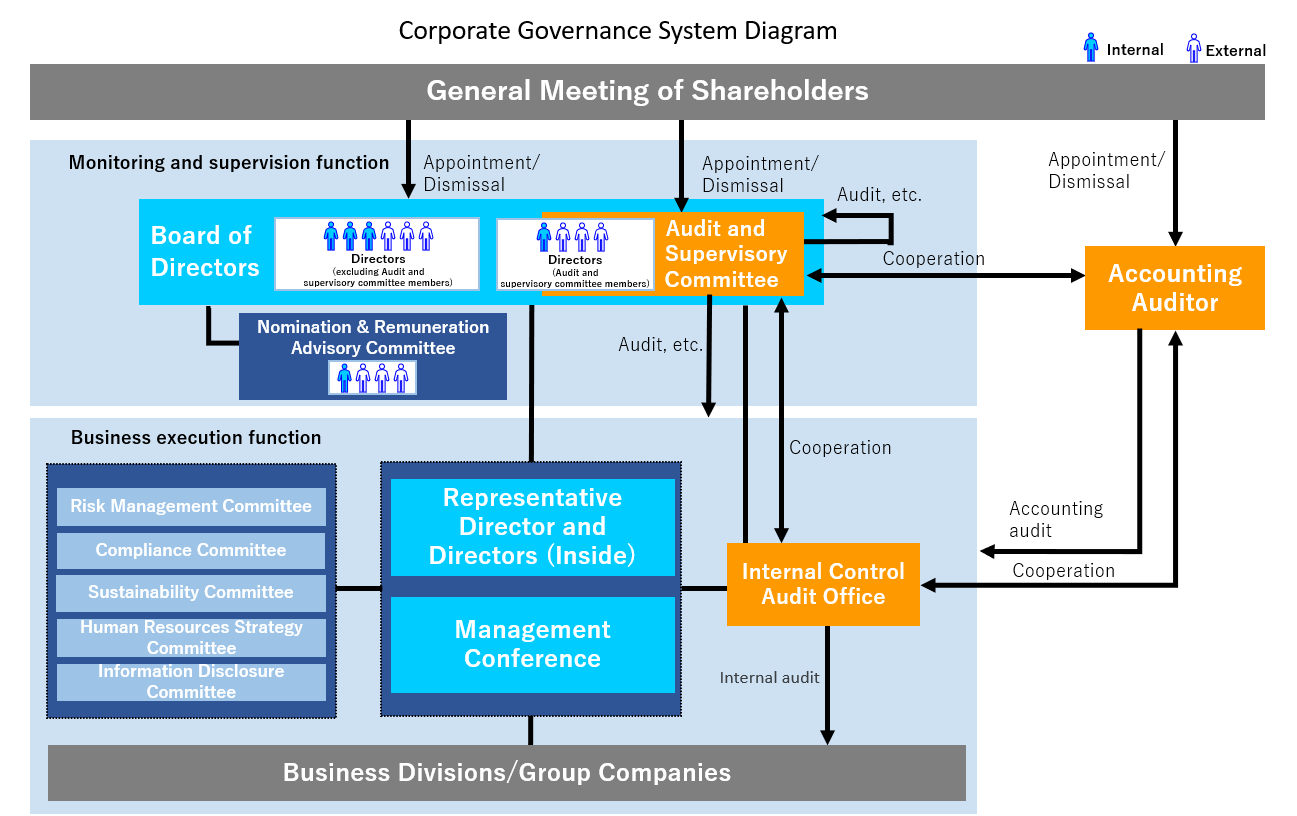
To ensure transparency, soundness, and efficiency of management, we have established the following bodies within the framework of a Company with an Audit and Supervisory Committee to establish a system with the aim of enforcement of oversight, audit, and decision-making functions, and swift execution of operations.
5.Corporate Governance Report
6.Matters Regarding Directors
1.Board of Directors and Audit and Supervisory Committee Members
Click here for Board of Directors and Audit and Supervisory Committee Members
2.Evaluating the effectiveness of the Board of Directors
To achieve sustainable growth and enhance corporate value, the Company regularly conducts evaluations of the effectiveness of the Board of Directors by a third-party organization to ensure that the Board of Directors appropriately fulfills its roles and responsibilities.
The results of the survey confirmed that The Board of Directors was confirmed to be functioning effectively overall. In particular, the following areas were confirmed to be effective.
· The Board of Directors is diverse in terms of knowledge, experience, expertise, gender, and internationality
· The Board of Directors sets policies for the Group’s overall business portfolio and conducts regular reviews from the perspective of ensuring sustained profitability
· The Company has appropriately established a framework for company-wide consideration and promotion of sustainability initiatives based on its governance structure
· Independent Directors actively provide advice based on their professional knowledge, and ask effective questions
・Main contents of the survey
- Respondents
- All members of the Board of Directors (Six Directors and four Audit & Supervisory Board Members)
- Evaluation method
- Anonymous questionnaire
- Summary of questions
- ・Composition of the Board of Directors
・Management of the Board of Directors meetings
・ Discussion at the Board of Directors meetings
・Monitoring function of the Board of Directors・Training
・Dialogue with shareholders (investors)
・Self-improvement
- Aggregation of results
- Outsourced to ensure objectivit
・Based on the results of this evaluation of the effectiveness, we have identified the following issues, and will work to further increase the effectiveness of the Board of Directors.
| Issues | Specific initiatives | |
| Issues Specific initiatives Issues to be continuously strengthened | In fiscal 2024, the Board of Directors created opportunities for free, open, and constructive discussions, opportunities to discuss medium-term management strategies, and opportunities to follow up on important resolutions approved by the Board of Directors. However, we recognized that these efforts were still insufficient. | ・Hold opinion-exchange sessions between Internal Directors and Independent Directors and conduct off-site meetings ・Increase opportunities for discussions regarding the 10-Year VISION and the Medium-Term Management Plan ・Provide progress reports on investment projects |
| Newly identified issues | We have newly identified the following issues: increasing discussions on management strategy, holding discussions on value creation using digital technologies, providing opportunities such as seminars for officers to acquire necessary knowledge, and creating opportunities for dialogue with Executive Officers and department general manager level personnel as part of the succession planning. | ・Conduct discussions on management that takes into account human capital, stock price, and the cost of capital ・Conduct discussions on DX initiatives ・Hold seminars for officers ・Provide opportunities for reports from Executive Officers and department general manager-level personnel at meetings of the Board of Directors |
3.Remuneration system
The Nomination & Remuneration Advisory Committee, an advisory body to the Board of Directors, deliberates on the remuneration system for officers and establishes the following basic policies:
- Design the system to motivate officers to contribute to the enhancement of corporate value
- Ensure the appropriateness of the method for determining and distributing remuneration
- Design the system to allow officers to share interests with shareholders through stock ownership
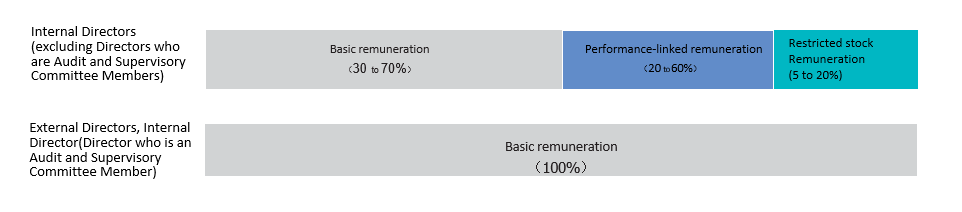
Remuneration for Directors consists of basic remuneration, performance-linked remuneration, and stock remuneration. The ratio of Directors’ remuneration by type is designed so that the higher a person’s position, the greater the proportion of performance-linked remuneration. External Directors who are responsible for the oversight function, are paid only basic remuneration, in light of their role.
The determination process and details shall be within the range approved by the General Meeting of Shareholders (Note 1) and shall be in accordance with the recommendation from the Nomination and Remuneration Advisory Committee, in which chaired by an independent External Director, to further increase transparency.
With regard to the performance indicators for performance-linked remuneration, in fiscal 2025, the achievement rates for the evaluation indicators of fiscal 2024 consolidated net sales, operating profit, operating profit margin, ROE, environmental initiatives, the ratio of women in management positions, and the ratio of non-Japanese directors at overseas subsidiaries linked to the Medium-Term Management Plan ranged from 51% to 100%.
For restricted stock compensation, a total of 16,978 shares were granted to three Directors excluding External Directors in fiscal 2025.
In fiscal 2024, to further enhance transparency, a third-party organization participated in the Nomination & Remuneration Advisory Committee, and discussions were held toward revising the remuneration system. The revised system, effective from fiscal 2025, is as follows:
Purpose of Revision
To strengthen governance and ensure the achievement of management plans amid rapid changes in the business environment, while promoting global growth and enabling Directors to further contribute to the enhancement of corporate value.
Key Points of Revision
1. Increase the proportion of performance-linked remuneration to encourage management that is more conscious of performance indicators.
2. Reduce the weight of financial indicators such as sales and profit, and increase the proportion of non-financial indicators such as ESG.
3. Revise performance indicators—including items, standards, and weights—to better align with the company’s vision.
4. Reduce the number of evaluation tiers for performance indicators to create a more distinctive and impactful performance-linked remuneration structure.
(Notes) 1.According to a resolution passed at the 106th Annual General Meeting of Shareholders held on June 26, 2026, the maximum amount of remuneration is set as follows:
Directors of the Board (excluding Directors who are Audit and Supervisory Committee Members): Up to 600 million yen per year
Directors who are Audit and Supervisory Committee Members: Up to 80 million yen per year
| Type of remuneration (composition ratio) |
Remuneration details |
|---|---|
| Basic remuneration (about 30 to 70%) (Note) |
・The amount is fixed by position according to responsibilities determined upon comprehensive consideration while referring to the levels of employees’salaries and remuneration levels at other companies. |
| Performance-linked remuneration (about 20 to 60%) (Note) |
・To raise awareness on improving performance each fiscal year, performance-linked remuneration is paid in cash in an amount reflecting the results of the performance indicator in the previous fiscal year. ・The target performance indicator and its amount are consulted with the Nomination & Remuneration Advisory Committee as necessary in accordance with changes in the environment and are reviewed based on its recommendations. ・Officers other than those with titles are eligible for bonuses, to be paid at a certain time each year in an amount obtained reflecting the degree of targets achieved for each individual. |
| Restricted stock remuneration (about 5 to 20%) (Note) |
・Restricted stock remuneration consists of restricted stock intended to further raise motivation to contribute to sustainably improving corporate value and shareholder value over the medium-to-long-term within the range approved at the General Meeting of Shareholders. ・The number of shares to be granted to Directors is resolved by the Board of Directors. ・The restrictions on shares are lifted when the Director retires. |
(Note) If there is a pronounced decline in performance, performance-linked remuneration and stock remuneration may fall below the stated range.
Therefore, basic remuneration may surpass the stated range.
4.The policies and procedures for nomination
* Please refer to the Corporate Governance Report [Principle 3-1. Enhancing information disclosure]
The policies and procedures for nominating candidates for Directors and Directors who are Audit and Supervisory Committee Members are set forth in internal regulations, and the selection criteria are
based on factors such as excellent character and insight, and extensive knowledge and experience in corporate management.
Directors and Directors who are Audit and Supervisory Committee Members are subjected to dismissal if they are not deemed to be contributing to the improvement of corporate value, or if there is misconduct in the execution of duties from the perspective of corporate governance or a material violation of laws and regulations.
Such decisions are made by the Board of Directors after consultation with the Nomination & Remuneration Advisory Committee.
Candidates for Directors who are Audit and Supervisory Committee Members are determined with the consent of the Audit and Supervisory Committee in advance.
5.Criteria for independence of External Officers of the Company
The Company deems an external officer or a candidate for the external officer to be independent of the Company if there is no risk of generating conflicts of interest with general shareholders of the Company. “No risk of generating conflicts of interest with general shareholders of the Company” refers to the case where an external officer or a candidate for the external officer is deemed not to fall under any of the following items.
(1) A person for which the Company and/or its affiliate (collectively, the “Group”) is a major business partner
(2) A major shareholder (Note 1) of the Company or a person executing the operations (“Executing Person”) thereof (Note 2)
(3) A person in which the Group holds 10% or more of the total voting rights directly or indirectly, or an Executing Person thereof
(4) A major business partner (Note 3) of the Group or an Executing Person thereof
(5) A person who belongs to an audit corporation which is an Accounting Auditor of the Company or its consolidated subsidiary
(6) A consultant, an attorney, a certified public accountant, or a person providing other professional services who has received a large amount of money or other properties (Note 4) from the Group other than as compensation for being an officer (if the recipient of such properties is a corporation, partnership or any other organization, such as a consulting firm, law office, and accounting office, this item applies to any person belonging to such organizations)
(7) A person who has received a large number of donations (Note 5) from the Group (if the recipient of such donations is a corporation, partnership, or an organization, this item applies to an Executing Person of such organization)
(8) An Executing Person of a company that elects an Executing Person of the Group as its officer
(9) A person that falls under any of the above items 2 to 8 in the past three (3) years
(10) If a person that falls under any of the above items 1 to 8 is a person in an important position (Note 6), a spouse, or a relative within the second degree of kinship thereof
(11) Other than the items set forth above, a person who is at risk of generating conflicts of interest with general shareholders and is reasonably deemed to be in a situation where he/she is unable to perform duties as an independent external officer
(Notes)
1. “A major shareholder” refers to a shareholder who holds 10% or more of voting rights under the name of itself or another person at the end of the most recent fiscal year of the Company.
2. “Executing Person” refers to an executive director, executive officer, operating officer, and a person equivalent to that, as well as an employee of a corporation or an organization. A non-executive director shall also be included in the above in case of judging the independence of an External Director who is an Audit and Supervisory Committee Member.
3. As to “a major business partner,” the significance of such transaction for the Group and the major business partner shall be assessed using an appropriate index, and an outline of the result thereof shall be disclosed so that the Company may practically determine the degree of risk of generating conflicts of interest. A major business partner refers to a person who makes a payment to the Company that accounts for 2% or more of the Company’s annual consolidated net sales in the most recent fiscal year.
4. As to “a large amount of money and other properties,” the significance of such money and properties for the Group and the recipient shall be assessed using an appropriate index, and an outline of the result thereof shall be disclosed.
5. As to “a large number of donations,” the significance of such donation for the Group and the recipient shall be assessed using an appropriate index, and an outline of the result thereof shall be disclosed.
6. “A person in an important position” refers to an executive director, executive officer, operating officer, or an employee in an upper management position such as a department manager or higher.