


News
Notice Regarding the Launch of the PATRI UEYES Tablet Inspection System
Notice Regarding the Launch of the PATRI UEYES Tablet Inspection System
In October 2026, CKD Corporation (Headquarters: Komaki City, Aichi Prefecture; Representative: Katsuhito Okuoka, President and CEO) will release the PATRI UEYES tablet inspection system, designed to be installed on visual inspection conveyors to automate visual tablet inspection.
Using a unique multi-color lighting technology, this system captures tiny tablet surface irregularities to detect chips of approximately 1 mm square and 0.5 mm deep. The new system offers 16 times* the detection performance of CKD’s previous model in terms of chip volume ratio, thereby contributing to labor savings and enhanced quality control at manufacturing sites.
*Compared with CKD’s Flash Patri inspection system for PTP packaging machines. Improves the size of detectable chips from approximately 2 mm square and 2 mm deep to approximately 1 mm square and 0.5 mm deep, a 16-fold increase in detection performance in terms of chip volume ratio.
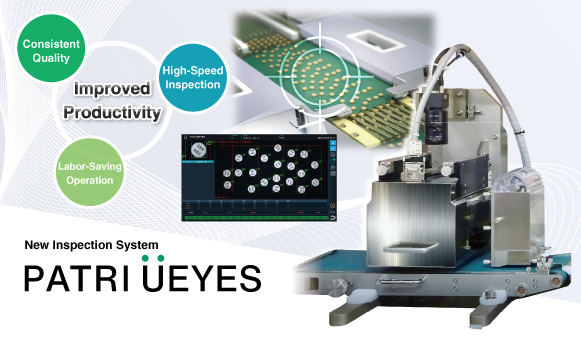
PATRI UEYES
1.Development Background
Pharmaceuticals and supplements manufacturing sites have broadly adopted inspection processes in which workers visually check tablets running over conveyors. While opportunities to use visual inspection conveyors have increased along with the growth in low-volume production of different products, this approach presents challenges in terms of dealing with labor shortages, stabilizing inspection quality, and digitizing inspection records. With this in mind, CKD developed PATRI UEYES, which is capable of performing high-accuracy visual inspections on existing visual inspection conveyors. To do so, CKD adapted the image processing technology developed for the Flash Patri series of inspection systems for PTP packaging machines.
2.Primary Applications
・Visual tablet inspection in pharmaceuticals and supplements manufacturing processes (mounted on visual inspection conveyors)
・Inspection for tablet cracks, chips, foreign matter, color variance, stamping defects, printing defects, etc.
3.Product Features
(1) Detects tiny chips with 16 times* the detection performance of CKD’s previous model
Uses a specially designed multi-color lighting technology to clearly capture tablet surface irregularities, thereby detecting tiny chips of approximately 1 mm square and 0.5 mm deep.
(2) Inspects the top and bottom of tablets using two 9-megapixel cameras
Equipped with two 9-megapixel color cameras, the system inspects the top and bottom of tablets in high definition.
(3) Converts inspection results into data to support quality control
Stores and manages inspection results as data, enabling them to be used as quality records. Retaining inspection evidence supports enhanced quality control.
(4) Able to output pass/fail judgment results for each tablet. Contributes to greater yields
Since pass/fail judgment results can be output for each tablet, this enables high accuracy selection control according to the equipment configuration. By selecting only defective tablets, this prevents unnecessary discharge of non-defective tablets, thereby contributing to improved yields and reduced product loss.
4.Primary Specifications
| Camera | 9-megapixel color camera: 2 [Resolution: approx. 30 μm/pix] |
| Light source | Multi-color lighting unit: 2 |
| Inspection target | Tablets (excluding capsules) |
| Inspection items | Inspection items Cracks, chips, area variance [maximum inspection accuracy: ±3%], surface chips [maximum inspection accuracy: chip opening width of 1.0 mm, 1.0 mm x 1.0 mm in the chip diameter direction, and 0.5 mm in the thickness direction], length variance (only for irregular-shaped tablets), color variance, foreign matter adhered to top/bottom [maximum inspection accuracy: 0.1 mm sq./φ25 μm x L2.5 mm], engraving defects, printing defects |
| Inspection capacity | 3,000 tablets/minute with a maximum conveyor speed of 6 m/minute, tablet diameter φ5 – 10 mm |
| Number of rows | 1 – 8 rows |
5.Sale price (excluding tax)
Discretionary
6.Sales plan
FY2028: 50 million yen
7.Release date
October 2026