What are Pipe Fittings? A Thorough Explanation of Types, Materials, and Selection Methods from an On-Site Perspective
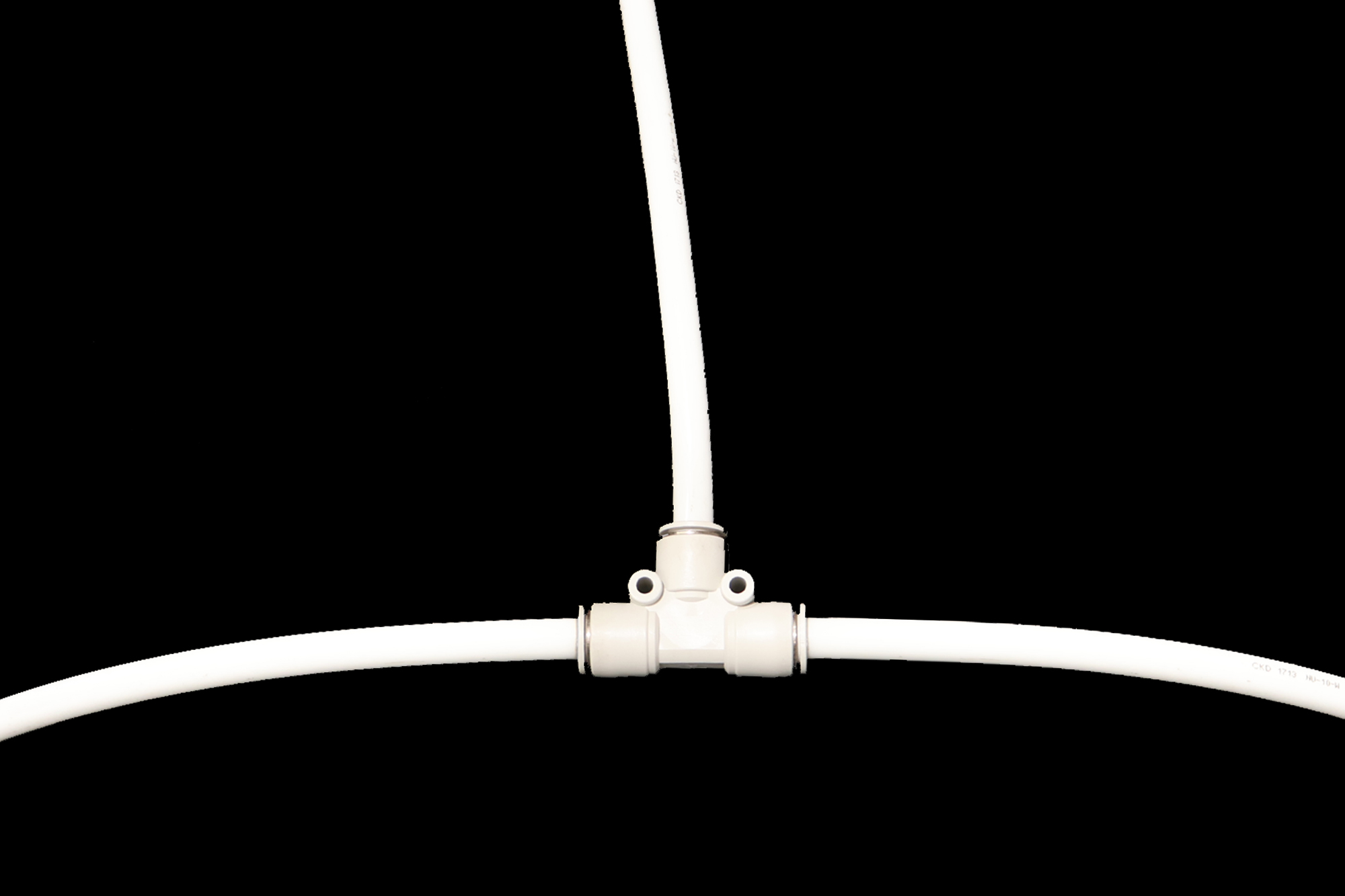
Fittings are essential connection parts for equipment maintenance, installed in piping systems to change the direction of fluids, branch them, or connect pipes of different diameters.
If the wrong type or material is selected, it can lead to cost losses due to air leaks and the risk of fire. This article explains the basics of mechanisms and types, "selection criteria that won't fail" chosen by professionals, and practical know-how to prevent on-site troubles, all from the perspective of facility maintenance.
- 3-1.Operating conditions | Fluid / Pressure / Temperature
- 3-2.Material compatibility | Avoidance of electrolytic corrosion risk
- 3-3.Workability and maintainability
- 3-4.Safety | Flame retardancy standard (UL94 V-0)
- 3-5.Air leak countermeasures | Prevent invisible cost loss
- 3-6.Total cost | Inventory management and Total Cost of Ownership (TCO)
What is a Fitting?
In pneumatic systems, a "fitting" is a general term for parts that connect pipes (pipes/tubes) to one another, performing functions such as extending fluid lines, branching, changing direction, connecting different diameters, or closing off lines. In Japanese, it is read as "tsugite," and in English, it is called a "Fitting" or "Joint." Defined as "pipe fittings" in JIS standards, they are finely classified by material, shape, and connection method.
Factory piping systems are often likened to “blood vessels” in the human body, and fittings serve as “branch points” that direct the flow.
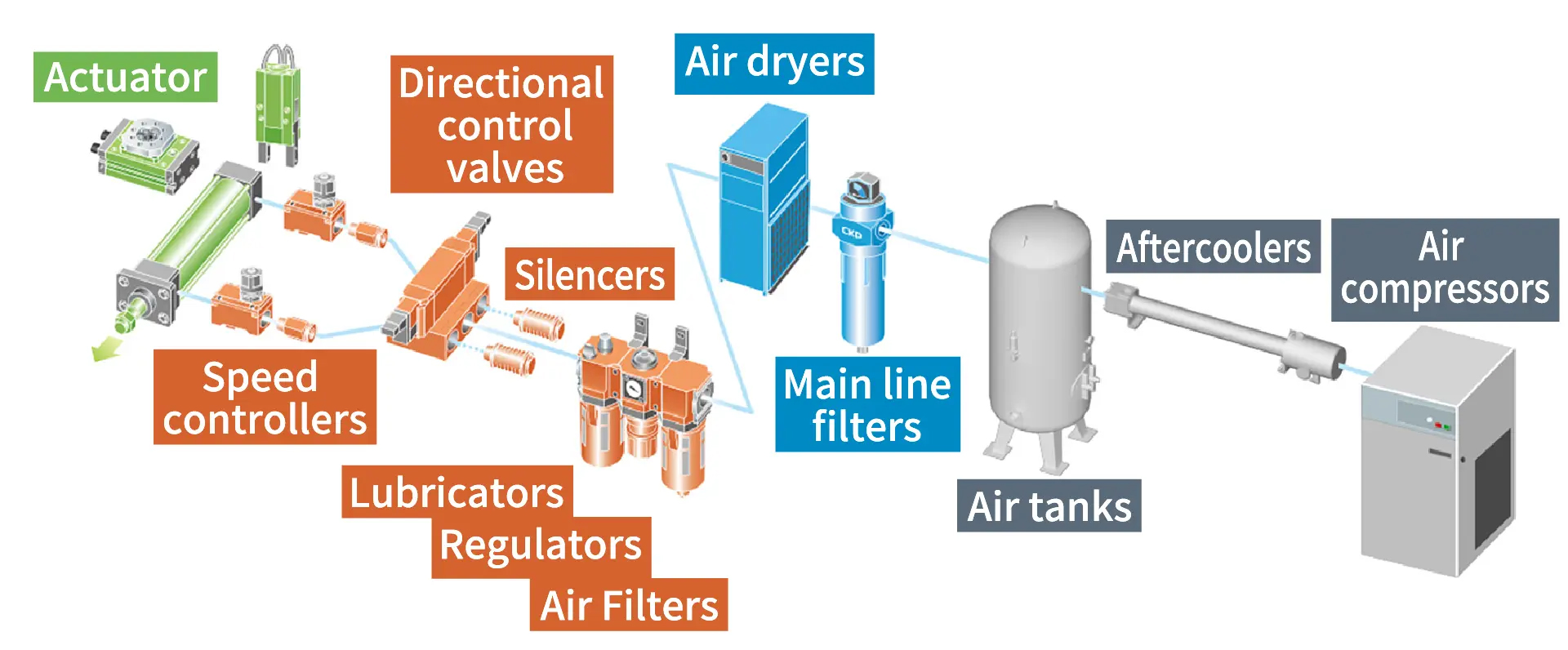
Fittings are used at all connection points where the blue lines (piping) in the diagram above meet each equipment component. They are placed at every point in the system, serving as critical "knots" to deliver fluid without leakage from the compressor to the actuator (end device). Selecting the wrong fitting can have serious impacts on the manufacturing site, including energy loss due to air leaks, ignition accidents caused by weld spatter, and sudden stops due to seal deterioration. To prevent such troubles, it is fundamental to correctly understand the types, materials, and connection methods of fittings and to select products suitable for the usage environment.
On-Site Troubles Caused by Fitting Defects
Fitting defects (leaks, clogs, breakage) are serious problems directly linked to factory-wide downtime.
In manufacturing sites, the mindset that "fittings are consumables, so just replace them if they leak" remains deeply rooted. However, this replacement work often leads to call-outs late at night or on holidays, exhausting maintenance personnel.
Common causes of air leaks include uneven wrapping of seal tape, poor seal adhesion due to diagonally cut tubes, and hardening of seals due to aging.
Even more serious is the fire risk. In welding lines, accidents have been reported where standard resin fittings melted and ignited due to spatter (welding sparks). There is a case where a manufacturer received a strict recommendation for correction from the safety management department after a worker mistakenly used a standard fitting near a welding area, causing a small fire. (Combined with previous segment in English flow, but contextually accurate).
Basics of Fitting Types and Selection
When selecting fittings, narrow down the choices based on three axes: Shape (what you want to do), Material (what the environment is), and Connection Method (how to install). Let's organize each option.
Selecting by Shape | List of Fittings by Purpose
The shape of the fitting is determined by "what you want to do." Choose the shape that fits your purpose from the table below.
| Purpose | Fitting Types | Features/Notes |
|---|---|---|
| Extend | Socket, Nipple | Nipple has male threads on both ends; Socket has female threads on both ends. |
| Change Direction | Elbow, Bend | Available in 45°/90°/180°. Street elbows save space. |
| Branch/Merge | Tee (Cheese), Cross | Crosses have high pressure loss, so two Tees are often used instead. |
| Change Diameter | Reducer, Bushing | Concentric and eccentric types available. Select eccentric to prevent liquid accumulation. |
| Make Detachable | Union, Flange | Use unions for maintenance points; flanges for large diameters. |
| Close Pipe End | Cap, Plug | Cap covers the outside (female); Plug inserts inside (male). |
| Hygienic Connection | Ferrule | For food and pharmaceuticals. Easy to disassemble and clean. |
| One-touch Detachment | Quick Coupling | Ideal for frequent connection/disconnection points. |
Selecting by Material | Matching Fluid and Environment
Fitting material is determined by "what fluid is used and in what environment."
| Purpose | Heat resistance | Corrosion resistance | Main applications | Precautions |
|---|---|---|---|---|
| Black iron fitting (Cast iron) | 〜350℃ | Low | Steam, oil, gas | Not suitable for water piping due to rusting |
| White iron fitting (Galvanized) | 〜120℃ | Medium | Industrial water, air conditioning, fire extinguishing | Protects base material via sacrificial corrosion protection |
| SUS304 | 〜400℃ | High | Food, general chemicals | General-purpose stainless steel |
| SUS316L | 〜400℃ | Extremely high | Chemicals, seawater, semiconductors | Resistant to chlorine environments |
| Brass | 〜150℃ | Medium | Pneumatic equipment, water faucets | Beware of dezincification corrosion |
| Bronze (Gunmetal) | 〜200℃ | High | Valves, high-pressure piping | For locations requiring long-term durability |
| PVC(PVC) | 〜60℃ | High | Drainage, water treatment | Not suitable for high temperatures or organic solvents |
| PBT (Flame resistant) | 〜120℃ | Medium | Pneumatic one-touch fitting | UL94 V-0 compliant products recommended |

Point:Checking flame resistance (UL94 V-0) is important for resin fittings. In environments where weld spatter flies, there is a risk of standard resin igniting. Details are explained in the "Safety" section described later.
Select by connection method | Decide based on workability and application
The connection method of the fitting is determined by "how it is installed" and "at what pressure and frequency it is used."
| Connection method | Advantages | Disadvantages | Main applications |
|---|---|---|---|
| Threaded type | Installable with tools, reworkable | Depends on application quality of seal tape | General piping of small to medium diameter |
| Flange connection | Large diameter/high pressure compatible, easy disassembly | Requires large space and high cost | Critical piping, large diameter |
| Welded connection | Highest strength, leak-resistant | Skills required, disassembly not possible | High pressure, high temperature, hazardous fluids |
| Bite type | High pressure compatible without welding | Torque control required | Instrumentation piping / Metal tube |
| One-touch type | No tools required, fastest installation | Packing quality is important | Pneumatic piping (Mainstream) |
Point:If choosing one-touch fittings, products adopting V-packing are recommended. Insertion is light, and the "self-sealing effect" where adhesion increases as pressure is applied makes it difficult to leak. Also, if you are concerned about seal tape application for threaded types, choosing pre-coated fittings (sealant applied) allows standardization of installation quality.
How to choose fittings without failure [6 Criteria]
You won't find the best one for the site just by gazing at the spec sheet in the catalog. Fitting selection is not "component selection" but "environment selection. " We explain 6 criteria for selecting products that are truly useful on site.
1. Operating conditions | Fluid / Pressure / Temperature
The first step in fitting selection is accurately grasping the operating conditions.
Type of fluid: Compatible materials differ depending on the fluid, such as air, water, oil, steam, chemicals, etc. Especially when handling chemicals, be sure to check the manufacturer's chemical resistance map.
Maximum operating pressure: It is necessary to allow for a safety factor considering pressure fluctuations and pulsation, rather than applying the catalog value as is.
Operating temperature: Packing deterioration accelerates in high-temperature environments. Particular attention to heat resistance temperature is required for resin fittings.
2. Material compatibility | Avoidance of electrolytic corrosion risk
When dissimilar metals are brought into contact, "electrolytic corrosion (galvanic corrosion)" occurs where one corrodes due to the potential difference. Connecting copper piping and stainless steel fittings directly risks corrosion on the copper side.
If there is a risk of galvanic corrosion, insulating fittings should be used, or the materials should be unified to the same type of metal. Particular caution is required in outdoor piping or environments with moisture adhesion.
3. Workability and maintainability
This is a point often overlooked at the design stage.
Installation in narrow spaces: When piping space is limited, workability can be improved by utilizing street elbows or rotary elbows.
Consideration for periodic inspection: Adopt unions or flanges for locations requiring frequent disassembly and inspection. We recommend actually measuring the space of the installation location and checking for interference using 3D CAD data.
4. Safety | Flame retardancy standard (UL94 V-0)
The flame retardancy of resin fittings is a point that cannot be overlooked from a safety perspective.
In environments where welding lines or electric sparks occur, there is a risk of standard resin fittings melting or igniting. The aforementioned small fire incident was also caused by the misuse of standard fittings. UL94 V-0 standard compliant products are mandatory in such environments. The V-0 standard indicates high flame retardancy performance where "the fire extinguishes within 10 seconds after flame contact, and there are no flaming drips."
However, there is a problem with the distinction of using "flame resistant for welding areas, and standard for others." It is the risk of worker misuse and the complication of inventory management.
To solve this problem fundamentally, the approach of unifying all resin fittings in the factory to flame resistant ones is effective. Since CKD's GW series adopts flame retardancy V-0 as "standard specification," safety can be secured without additional cost, and inventory can be unified. The idea of "raising the grade of standard products" rather than "buying additional dedicated products" structurally improves safety management on site.
5. Air leak countermeasures | Prevent invisible cost loss
Air leaks quietly undermine factory profitability as "invisible cost losses."
The main causes and countermeasures for air leaks caused by fittings are as follows.
| Cause | Countermeasure |
|---|---|
| Defective tube cut surface | Thoroughly perform right-angle cutting with a dedicated tube cutters |
| Defective seal tape application | Adopt pre-coated fittings to eliminate installation variability |
| Aging deterioration of packing | Select products adopting V-packing (stable due to self-sealing effect) |
| Deformation/twisting of tube | Relieve twisting stress with rotary elbows |
Periodic leak checks using soapy water are also effective.
6. Total cost | Inventory management and Total Cost of Ownership (TCO)
A common mistake in fitting selection is judging only by "unit price of parts."
The true cost of fittings should be evaluated by "Total Cost of Ownership (TCO)." TCO includes the following.
| Cost item | Content |
|---|---|
| Initial cost | Parts purchase cost |
| Replacement cost | Man-hours for replacement work due to deterioration or failure (including late-night and holiday support) |
| Downtime cost | Opportunity loss due to line stoppage |
| Inventory management cost | Personnel and storage costs for managing multiple product types |
| Risk cost | Loss in the event of fire or leakage accidents |
By unifying to fittings with high durability and flame retardant standards, total cost reduction can be expected through reduced replacement frequency, reduction of inventory types, and elimination of misuse risk, even if the unit price of parts increases.
[By Industry] Focus points for fitting selection
The requirements for fittings differ depending on the industry and site environment. We introduce selection points in 4 representative industries.
Manufacturing / Automotive | Flame retardancy and air leak countermeasures
In environments where welding processes and assembly processes coexist, the adoption of flame-retardant fittings and countermeasures against air leaks are important points. If products with flame retardancy as standard specifications are adopted, differentiation by area becomes unnecessary.
Also, with the increase in multi-jointed industrial robots, the "thickness" and "hardness" of piping inside the arm are increasingly becoming issues. CKD's "Air Fiber" uses an ultra-fine tube with an O.D. of φ1.8 mm, and by combining it with dedicated fittings, it can realize energy saving without hindering robot movement.
Food / Pharmaceuticals | Hygiene and cleanability
In environments where compliance with HACCP or FSSC22000 is required, adoption of sanitary fittings (ferrules) is mandatory. Be sure to confirm compliance with surface roughness (Ra value) management, SUS316L material, and FDA certified materials.
Building facilities | Regulatory compliance and piping types
There are pipings where materials and installation methods are determined by the Fire Service Act and Building Standards Act. Caution is required because mistaking the distinction between white iron fittings and PVC fittings can lead to legal violations in some cases.
Plant / Chemical | Chemical resistance
Chemical resistance is the most important point. In strong acid/strong alkali environments that even SUS316L cannot withstand, Hastelloy or fluororesin fittings are required.
In semiconductor and lithium-ion battery manufacturing, dust generation prevention, oil-free, and metal-free specifications are required. CKD's Fine System (P70/P74 Series) suppresses dust generation to the limit through assembly inside a clean room and double packaging.
Frequently Asked Questions (FAQ)
We have summarized frequently asked questions regarding fittings in a Q&A format. We publish answers useful on-site, ranging from basic content to points that are easy to get lost in practice.
Q. What are "Male" and "Female" fittings?
A. External thread (convex shape) is "Male," and internal thread (concave shape) is "Female." Nipples are male at both ends, sockets are female at both ends, and street elbows have a structure of one side each.
Q. What is the difference between A designation and B designation?
A. There are two types of size notation for fittings: A designation (metric system) and B designation (inch system). In Japan, A designation (15A, 20A, 25A...) is mainstream, while B designation (1/2B, 3/4B, 1B...) is used in the US and some plant facilities.
| A Designation | B Designation | Outer Diameter (Steel Pipe) |
|---|---|---|
| 6A | 1/8B | 10.5mm |
| 8A | 1/4B | 13.8mm |
| 10A | 3/8B | 17.3mm |
| 6A | 1/8B | 10.5mm |
| 15A | 1/2B | 21.7mm |
| 20A | 3/4B | 27.2mm |
| 25A | 1B | 34.0mm |
| 32A | 1-1/4B | 42.7mm |
| 40A | 1-1/2B | 48.6mm |
| 50A | 2B | 60.5mm |
Note that the nominal diameter is a "nominal size" and does not match the actual outer diameter. Please note that the steel pipe O.D. of "25A" is 34.0 mm, not "25 mm".
Q. How many times should I wrap seal tape?
A. Generally, 6 to 8 turns is the standard. It is an iron rule to wrap in the threading direction (clockwise) and leave 1 to 2 threads at the tip. If you are concerned about variations in installation quality, consider adopting pre-coated fittings.
Q. What is the difference between TS fittings and DV fittings?
A. Both are PVC fittings, but TS fittings are for water supply (bonded type), and DV fittings are for drainage (insertion type/adhesion unnecessary). The two are not compatible, and using a DV fitting for water supply will not withstand the water pressure and will cause water leakage.
Q. How long is the service life of a fitting?
A. It varies greatly depending on the usage environment. What is important is not "replacement by service life years" but "periodic inspection and setting replacement criteria." An approach of periodically checking for leaks, corrosion, and deformation, and replacing proactively is recommended.
CKD's fitting lineup
Based on the 6 selection criteria explained so far—operating conditions, material compatibility, workability, safety (flame retardancy), air leak countermeasures, and total cost—we introduce CKD's lineup of fittings for pneumatic piping.
The corresponding fluid is "compressed air" or "air," and they are utilized to realize clean and efficient piping in factory air blow facilities, pneumatic control systems, etc. Please select the best product according to the application and environment.
* On smartphones, horizontal scrolling is supported.
| Product Name | Model No. | Image | Suitable fluid | Connection size (*) |
Features | Differentiation Point |
|---|---|---|---|---|---|---|
| Fitting | GW | 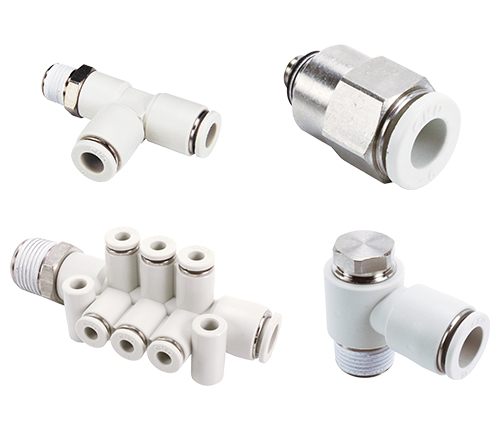 |
Compressed air | M3〜1/2 | Flame retardant, can significantly reduce piping space | General fitting. Has the most variations. |
| Fitting Stainless steel type | ZW | 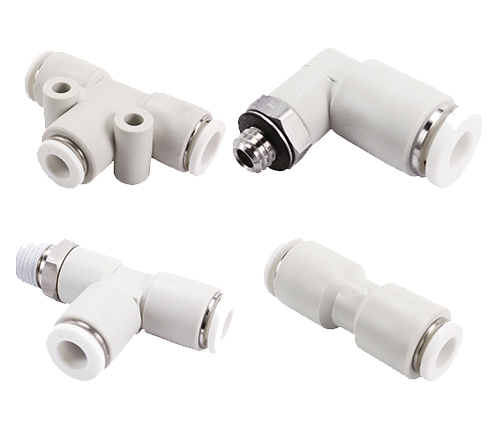 |
Compressed air | M5〜R1/2 | Contributes to flame retardancy and space saving. Metal parts are all stainless steel | When used in environments with flammable gases or substances |
| Fitting (Mini fitting) |
GWJ | 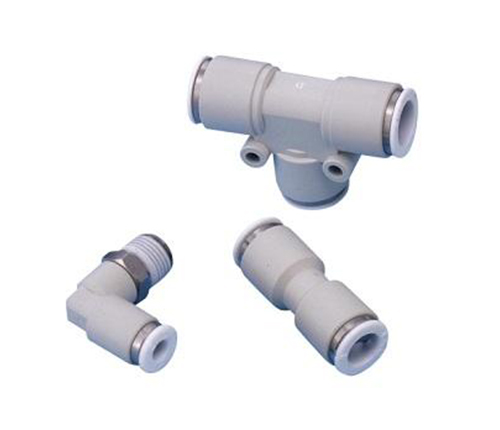 |
Compressed air | M3〜1/8 | Space-saving type with further miniaturized body size. Can significantly reduce dead space in piping | When piping space is narrow or you want to pipe compactly |
| Fitting Stainless steel type | ZSP | 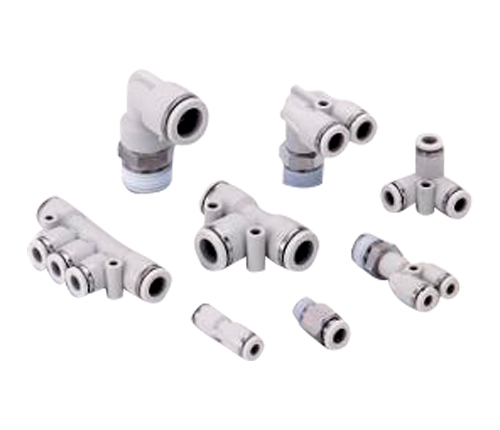 |
Compressed air | M5、R1/8〜1/2 | Stainless steel (equivalent to SUS303) is adopted for the metal body part. Ideal for use in corrosive atmospheres or atmospheres where copper ions are undesirable | When used in environments where temperature is high, etc., and iron parts easily corrode |
| Miniature fitting | F | 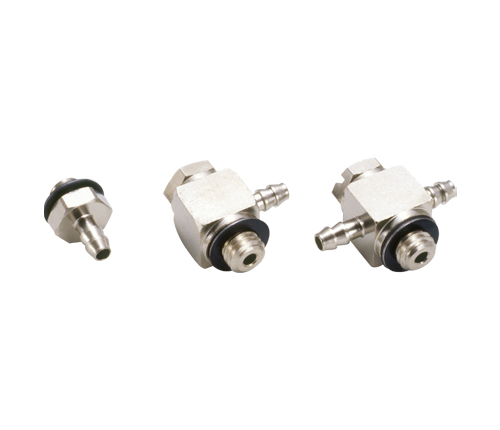 |
Compressed air | M3〜1/8 | Ultra-compact type | When using small connection systems or thin tubes |
| Tightening fitting / fitting | MJ・JL | 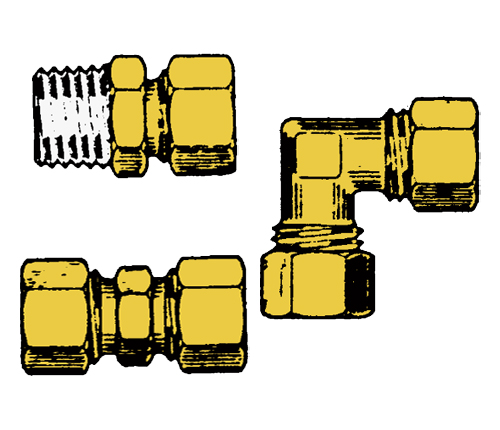 |
Compressed air | 1/8〜1/2 | Stable and secure piping possible with double chuck mechanism. Excellent reliability tightening joint, can also be used for copper tubes | When a fitting with strong chucking force is required, such as when tubes come off easily |
| Rotary fitting | RJF | 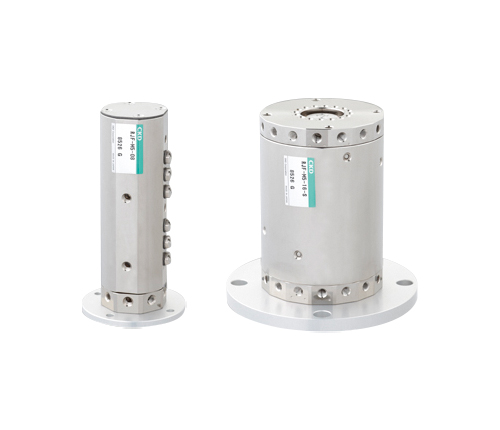 |
Compressed air | M5、Rc1/8 | Pneumatic air supply joint for rotating shafts such as index tables, rotary tables, rotary drums, air cylinders, air blows, switching valves, etc. High rigidity and low sliding resistance realized by built-in bearing | When failures occur due to twisting of piped tubes caused by rotation |
| Air Fiber・ dedicated fittings |
PTN2・PTNL2・PG・CG・RG | 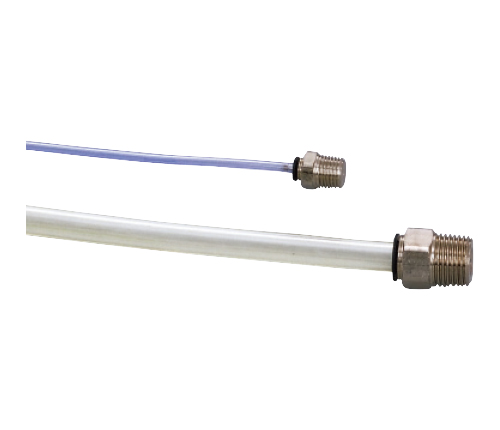 |
Compressed air | M3,M5、R1/8、Φ4、Φ6 | Ultra-fine size can significantly reduce piping space. Easy attachment and detachment. Since flexibility is remarkably superior and piping freedom is extremely high, difficult piping in narrow spaces or short-distance piping is easy. | When using air fiber tubes that are ultra-fine with little reaction force and used in clean environments. |
* Connection sizes are indicated in "B designation" (inch basis). Please refer to the FAQ above for conversion with A designation.
Summary
Fittings are essential elements that determine the reliability of the piping system.
From the source to the terminal equipment, fittings change the direction of fluid, branch it, connect pipes of different diameters, and enable the equipment to function. However, if selection is slighted with the perception that "all fittings are the same," it causes problems such as cost loss due to air leaks, fire risk due to welding spatter, and fatigue of maintenance personnel due to sudden stops.。
By making the 6 selection criteria explained in this article—operating conditions, material compatibility, workability and maintainability, safety (flame retardancy), air leak countermeasures, and total cost (TCO)—the judgment axis, on-site issues can be solved structurally.
Selecting fittings from the perspective of "factory-wide risk management" rather than "part unit price" leads to essential improvement in equipment maintenance.
Please consult CKD for fitting selection
CKD's experienced staff will respond politely to consultations such as "I want to review fittings but don't know which product to choose," "I want to consider unifying to flame-retardant fittings," or "I want to strengthen air leak countermeasures."
We will firmly listen to your issues and requests and propose the best products.